
Peek Behind the Curtain: NAACLS Standards Revision and Adoption Process
By Tara Cepull, MA, Content Creator, Writer, and Editor
NAACLS is currently requesting public comment on standards changes discussed during the September 2026 Board of Directors meeting. With that in mind, this article offers a behind-the-scenes look at how new standards are proposed and adopted, how existing standards are revised, and how programs can stay informed throughout the process.
How Existing Standards Are Reviewed and Revised
Under NAACLS established policies and procedures, all standards undergo a full review and consideration for revision approximately every 10 years. Between full reviews, the NAACLS Board of Directors, staff, volunteers, and review committees monitor trends and identify opportunities to clarify standards when needed.
This ongoing monitoring includes reviewing program citations, responding to questions from program directors, considering proposed changes from review committees, and noting broader educational or industry trends that may affect accredited programs.
When several programs receive similar citations or program directors frequently ask for clarification about a particular standard, NAACLS may determine that the standard should be revised for clarity. The goal is to ensure standards provide enough structure to support quality education and prepare students for careers in clinical laboratory science. An example of this occurred with Standard II during the 2024 Standards revision. As the most frequently cited standard at the time, Standard II was identified as an opportunity for improvement. A fourth component entitled “Feedback” was added to Standard II during this revision to emphasize the importance of documenting how stakeholder feedback can be utilized to inform program improvements.
NAACLS may also convene a task force if programs consistently request a significant addition to the standards. Task forces investigate the issue and develop language for the Board of Directors to consider, either as an addition to an existing standard or as a new standard altogether. They are generally used for larger standards-development work rather than individual, editorial revisions. When a task force is formed, it includes content experts and a public member who does not work directly in clinical laboratory science.
How a New Standard Is Developed
Once a need for a new standard is identified, NAACLS staff and appropriate content experts typically draft the initial language. In some cases, a task force is formed to lead this work, although not every new standard requires one.
- NAACLS Staff, content experts, or Task Force draft proposed language to address the identified need.
- Review committees discuss the draft and recommend additions, deletions, or clarifications while keeping the language as concise as possible.
- Once the review committees are satisfied with the verbiage, the draft is presented to the NAACLS Board of Directors for discussion.
- Board members consider the proposed language, its overall impact, and whether it should move forward for public comment.
When the Public Weighs In
After Board discussion, NAACLS requests public comment when a proposed new or significantly revised standard is expected to affect most or all programs. Public comment is an essential part of the accreditation standards revision process. While NAACLS Staff and Volunteers bring considerable expertise to the development of standards, public comment provides the community with an opportunity to identify areas needing clarification, consider unintended consequences, and ensure that standards remain relevant to the evolving needs of clinical laboratory education and the profession. Ultimately, this collaborative process helps NAACLS develop standards that are both meaningful and practical to implement.
Comment opportunities are shared through a link on the NAACLS website, on LinkedIn, and by email to subscribers of NAACLS News. The most recent request for public comment was posted in May 2026 regarding proposed changes to the 2024 adopted standards, and now there is a new request for public comment as a result of standards discussions during the September 2026 NAACLS Board meeting.
Public comments are typically collected for 30 to 60 days, with a specific deadline included when the request is posted.
How Standards Changes Are Finalized and Implemented
After the comment period closes, the proposed standard returns to the review committees for further consideration. Committee members evaluate whether the comments call for revisions and, if so, whether the changes are substantive or editorial. They also consider how much the proposed change would affect accredited programs. If substantive revisions are made, NAACLS may seek additional public comment.
When the review committees are satisfied with their proposed language, the standard is returned to the Board of Directors for consideration, finalization, and adoption. Once adopted, NAACLS notifies the public and accredited programs of the changes. When standards change substantively, staff will provide an effective date for the implementation. Programs that have received their Notification of Renewal and are already preparing accreditation materials will not need to address these changes in their current self-study or site visit. However, these programs will be expected to comply with the revised Standards once they take effect and address them in subsequent accreditation reviews, as applicable. Since Standards may be revised after each biannual Board meeting, programs should regularly check the NAACLS website to ensure they are following the most up-to-date standards.
Standards Compliance Guide
After standards are approved, the Standards Compliance Guide (SCG) must be updated to reflect the changes. The SCG is a companion document to the standards, designed to assist program officials in understanding and demonstrating compliance with the requirements. To avoid unnecessary revisions, compliance guide language is not developed until the corresponding standard has been approved, as proposed standards language may undergo several revisions before final approval. NAACLS relies on the expertise of review committee members to draft compliance language.
NAACLS updates documents such as the SCG on an ongoing basis, so it is important to reference our website for the most current versions of the Standards Compliance Guide, standards, and other resources. Together, these documents support transparency, clarify expectations, and support programs with strengthening their clinical laboratory science educational programs.
How to Stay Up to Date
After each biannual Board meeting, NAACLS Staff and Volunteers provide updates through Dr. NAACLS broadcasts. These interactive sessions are hosted on Zoom so participants can ask questions live. Recordings are archived on NAACLS’ YouTube channel for on-demand viewing.
Alongside the Dr. NAACLS broadcasts, NAACLS posts spreadsheets that clearly identify proposed revisions to existing standards and adopted changes. Below is an example:
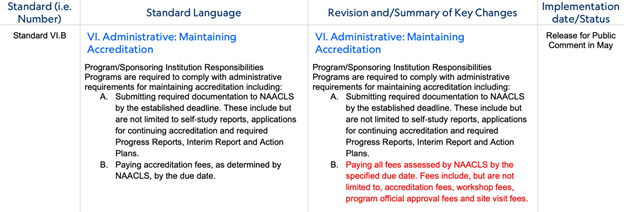
When NAACLS seeks public comment on proposed standards, announcements are shared through NAACLS News and LinkedIn. To stay informed and participate in opportunities to provide feedback, programs are encouraged to subscribe to NAACLS News and follow NAACLS on LinkedIn.
The NAACLS website serves as the central resources for current Standards, Guides, announcements, and other important updates. Programs are encouraged to regularly review these resources to remain aware of changes, understand their implications, and maintain ongoing compliance with the NAACLS Standards.